

How to Measure Wheel Stud Pattern
Preparing your vehicle for winter requires more than choosing the right tires. Before purchasing replacement wheels or booking a seasonal tire change, it is important to understand your vehicle’s wheel stud pattern. The correct bolt pattern ensures that your wheels fit securely and meet your vehicle’s specifications.
For Calgary drivers, winter road conditions can bring snow, ice, and freezing temperatures. Choosing the right wheels and tires is an important part of preparing for these seasonal challenges. Whether you are purchasing a separate set of wheels or arranging Winter Tire Change Services in Calgary, knowing how to measure your wheel stud pattern can help prevent incorrect wheel selection.
At OK Tire Macleod Trail, we understand the importance of proper tire fitment and seasonal vehicle preparation. In this guide, we explain how to measure your wheel stud pattern, why it matters, and what other wheel specifications you should check before installing winter tires.
Why Understanding Your Wheel Stud Pattern Matters
A wheel stud pattern, also called a bolt pattern, refers to the number of bolt holes on a wheel and the diameter of the imaginary circle they form. It is generally represented by two numbers, such as 5×114.3.
The first number indicates the number of bolt holes, while the second represents the diameter of the bolt circle in millimetres.
Ensures Proper Wheel Fitment
Every vehicle has specific wheel fitment requirements. Selecting wheels with an incorrect bolt pattern can prevent them from sitting properly against the wheel hub. This may create installation difficulties and potential safety concerns.
When arranging winter tire installation in Calgary, checking the bolt pattern helps ensure that your replacement wheels are compatible with your vehicle.
Helps Prevent Wheel Installation Problems
Incorrect wheel fitment can affect how securely a wheel sits against the hub. Poor alignment between the wheel and mounting points may contribute to vibration, uneven seating, and other installation problems.
Measuring the bolt pattern before purchasing replacement wheels helps you avoid choosing an incompatible set.
Makes Seasonal Tire Changes Convenient
Many Calgary drivers prefer keeping a separate set of wheels for their winter tires. This can make seasonal changes more convenient because the tires do not need to be removed from the wheels every time.
Knowing your vehicle’s wheel specifications also makes it easier to select compatible wheels when preparing for winter tire change Calgary appointments.
How to Measure Your Vehicle’s Wheel Stud Pattern
Measuring your wheel stud pattern is relatively straightforward when you understand the correct method. The process depends on the number of bolt holes on your wheel.
Step 1: Count the Bolt Holes
Start by identifying the number of bolt holes on your wheel. Most passenger vehicles have four or five bolt holes, while some SUVs and trucks have six or eight.
Counting the holes is the first step in identifying your vehicle’s bolt pattern.
Step 2: Measure a Four-Lug Wheel
For a four-lug wheel, measure the distance from the centre of one bolt hole directly across to the centre of the opposite bolt hole.
For example, if the measurement is 100 mm, the bolt pattern is written as 4×100.
Step 3: Measure a Five-Lug Wheel
Five-lug wheels require a slightly different measuring method because they do not have directly opposite bolt holes.
Measure from the centre of one bolt hole to the outer edge of the bolt hole positioned directly across from it. This provides an approximate bolt circle measurement. A dedicated bolt-pattern gauge or manufacturer specifications can help confirm the exact measurement.
For example, a five-lug wheel with a 114.3 mm bolt circle has a 5×114.3 bolt pattern.
Step 4: Measure Six- and Eight-Lug Wheels
For six- and eight-lug wheels, measure from the centre of one bolt hole to the centre of the opposite bolt hole. This measurement helps determine the bolt circle diameter.
Always verify your measurement against the vehicle manufacturer’s specifications before purchasing replacement wheels.
Common Wheel Stud Patterns and Their Measurements
Different vehicles use different bolt patterns depending on their design, size, and manufacturer. Knowing some common measurements can help you understand how wheel specifications are represented.
The following table provides examples of commonly used wheel stud patterns.
| Number of Bolt Holes | Example Bolt Pattern |
|---|---|
| Four-lug | 4×100 mm |
| Five-lug | 5×100 mm |
| Five-lug | 5×114.3 mm |
| Six-lug | 6×139.7 mm |
| Eight-lug | 8×165.1 mm |
These are general examples. Always check your specific vehicle’s requirements because the same manufacturer may use different bolt patterns across different models and production years.
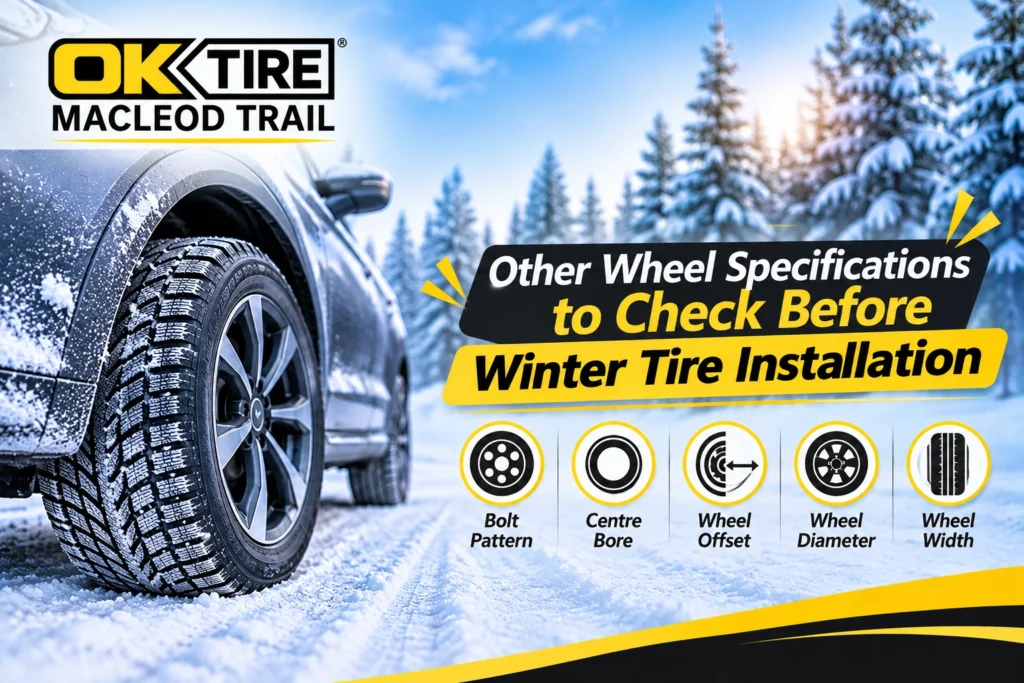
Other Wheel Specifications to Check Before Winter Tire Installation
Checking the bolt pattern alone is not enough to guarantee correct wheel fitment. Several other measurements should also be considered when selecting wheels for winter tires in Calgary.
Wheel Centre Bore
The centre bore is the opening in the middle of the wheel that fits over the vehicle’s hub. It must be large enough to fit over the hub correctly.
If the centre bore is too small, the wheel will not fit. If it is larger, an appropriate hub-centric ring may be required, depending on the wheel and vehicle specifications.
Wheel Offset
Wheel offset refers to the position of the wheel’s mounting surface relative to its centreline. Incorrect offset can affect the clearance between the wheel, suspension components, brake system, and wheel arches.
When choosing wheels for winter tires in Calgary, checking the offset helps ensure that the wheels fit within the manufacturer’s recommended specifications.
Wheel Diameter and Width
Wheel diameter refers to the overall size of the wheel, while wheel width measures the distance between its inner and outer flanges.
Both measurements are important when selecting replacement wheels. The correct size helps maintain proper clearance and compatibility with your vehicle’s recommended tire dimensions.
| Wheel Specification | What It Means | Why It Matters |
|---|---|---|
| Bolt Pattern | Number of holes and bolt circle diameter | Ensures correct mounting |
| Centre Bore | Diameter of the centre opening | Allows proper hub fitment |
| Wheel Offset | Position of the mounting surface | Maintains component clearance |
| Wheel Diameter | Overall wheel size | Ensures size compatibility |
| Wheel Width | Distance between wheel flanges | Supports correct tire fitment |
Choosing the Right Winter Tires and Wheels in Calgary
Calgary winters can bring changing road conditions, including snow-covered streets, icy intersections, and freezing temperatures. Selecting suitable winter tires and compatible wheels can help prepare your vehicle for these conditions.
Consider Your Driving Conditions
When shopping for winter tires in Calgary, consider your regular driving routes, vehicle type, and typical winter conditions. Drivers who frequently travel on snowy roads may have different requirements from those who mainly drive on cleared city streets.
Choosing tires that meet your vehicle manufacturer’s recommendations is an important starting point.
Are Studded Winter Tires Worth Considering?
Some drivers consider studded winter tires in Calgary for additional traction on icy surfaces. These tires contain small metal studs designed to provide extra grip in certain winter driving conditions.
However, studded tires may not be necessary for every driver. Consider your driving environment, road conditions, and applicable regulations before making a decision.
Understand Winter Tire Change Costs
The winter tire change cost can vary depending on your vehicle, tire size, wheel type, and the services required.
For example, changing complete wheel-and-tire assemblies may involve different work from removing existing tires and mounting another set onto the same wheels. Balancing and additional services may also affect the final cost.
Before booking, ask about the services included in your estimate so you can understand the work required.
Prepare Your Vehicle for Winter with Professional Tire Services
Get Your Wheels and Tires Checked Before Winter
Selecting the right wheels is only one part of preparing your vehicle for winter. Tire condition, tread depth, pressure, and proper installation are also important considerations.
If you are planning Winter Tire Change Services in Calgary, having your wheel specifications checked can help prevent fitment issues and make your seasonal preparation easier.
OK Tire Macleod Trail helps Calgary drivers with their seasonal tire service requirements. Whether you need assistance with winter tire installation in Calgary or want guidance on selecting suitable winter tires, professional assistance can help you make informed decisions.
Why Choose OK Tire Macleod Trail for Winter Tire Services?
Preparing your vehicle for winter requires attention to the details that affect tire performance and wheel compatibility.
OK Tire Macleod Trail provides tire services to help drivers prepare for Calgary’s changing seasonal conditions. From seasonal tire changes to installation assistance, getting the right service can help you maintain a suitable winter tire setup.
If you are considering winter tire change Calgary services, contact OK Tire Macleod Trail to discuss your vehicle’s requirements and plan your seasonal tire change.
Conclusion
Understanding how to measure your wheel stud pattern can help you choose compatible replacement wheels and avoid unnecessary installation problems. Remember to check the bolt pattern, centre bore, offset, diameter, and width before selecting a new wheel set.
As winter approaches, choosing suitable tires and ensuring correct wheel fitment can help prepare your vehicle for Calgary’s challenging road conditions. Contact OK Tire Macleod Trail for professional assistance with Winter Tire Change Services in Calgary and get your vehicle ready for the winter season.

